Showing posts with label Healthcare. Show all posts
Showing posts with label Healthcare. Show all posts
Thursday, February 12, 2015

Thursday, August 21, 2014
Heart Health!
Lorde-Glory and Gore
In light of Swimming's cholesterol, I'll be posting here some information on how to take control of your heart health. For ten years now, Swimming has controlled elevated LDL and overall cholesterol (genetic) through diet and exercise; each year being more active and healthier than the previous. Please note that if you have problematic H. pylori (the bacteria that is the cause of most duodenal ulcers--we all have it but certain cases it becomes out of control) can also increase LDL levels (due to inflammation that the bacteria causes in the intestines) and can also lead to atherosclerosis. The literature is limited on this relation, however, it points to something interesting that might be occurring. As a side note: anyone dealing with GERD or ulcers that haven't subsided with short-term use of medication should also have their gastrin levels checked.
(1) Several months ago the American Heart Association and American College of Cardiology just released new guidelines for cholesterol levels and therapeutics:
Here's the reader's digest version.
Here's the longer Times summary.
Here is the AHA's summary of their 4 new guidelines.
Here's their online calculator to figure out your risk of heart disease and stroke.
Lastly, here's AHA guideline resource center which has more info on CV disease, diabetes, obesity and the guidelines.
Here are the full guidelines (NB: both these organizations have industry disclosures.)
-Anyone dealing with this or at risk read the guidelines and if you have questions ask (myself and I'll consult with my resources or your own physician.) The new guidelines account for the multitude of side-effects the may come with the use of cholesterol-lowering drugs. (FYI all drugs are not created equal. Unfortunately I've personally seen these drugs handed out like candy after a pharm rep dropped off a bunch of samples at a Cardiologist's office.) I personally have been incredibly vigilant about modifying lifestyle as much as possible so I can delay the use of medication by keeping my overall cholesterol to <200 and my LDL to around 100 or less (my earlier discussion reg. my ulcer has totally messed this up for me.) Statins are extremely effective at lowering cholesterol but for many the use of statins come at a high price. Anyone on the border that could avoid statin use with diet and exercise should strongly consider doing everything they can to delay their start of statins therapy (esp if you're like me and are in your 20s or 30s.) Statins are powerful at lowering the risk of Cardiovascular disease and this coupled with the other advancements (Stents etc...) in cardiology have collectively decreased cardiovascular deaths in the past 30 years tremendously and have also increased the life span of humans. With that said, please please please do your part to take care of your heart! How? read further!
(2) Cooking for lower cholesterol
and here's some more information on a low fat diet.
-This is really just good information. I have been on a low fat, low sodium, high fiber diet for some time now and the initial transition I had to make when I was 18 was difficult but well worth it. I haven't really had fast food in a very long time, I just don't even go for anything fried (this was easy to give up since fried foods also cause acid reflux). I love steamed veggies! Letting go of cookies and ice cream is just plain hard since I love both. I'm not fully there yet but I would say now every few months I allow myself these treats (mainly seasonal.)
(3) Good background information on fats and cholesterol.
(4) Warning: fish oil supplements have also been known to raise LDL.
(5) Some last links--info and debate on statins (from the evidence I've read I see that they are beneficial, but I always think the first line of defense should be diet and exercise):
http://www.bmj.com/content/338/bmj.b2376
http://www.nytimes.com/2013/11/14/opinion/dont-give-more-patients-statins.html?_r=0
http://www.bmj.com/content/347/bmj.f6123
Saturday, May 24, 2014
Bonjour de Genève!
Je passé un bon moment en Genève et en Annecy! Ici des photos!
À bientôt!
Here is beautiful Geneva!


Melinda Gates at the UN!

Beautiful Annecy!

Friday, February 7, 2014
Medical Musings from this week!
Lana Del Ray-Summertime Sadness Remix
First off, GO TEAM USA at Sochi!!! Getting excited for the Olympics--beautiful opening ceremony per usual...let the games begin! I love the Olympics. For some reason I'm always extra motivated when they come around. Plus Iove watching the fanfare of the opening ceremony. How wonderful for the world to unite on one stage!
(1) Another reason sugar is awful: it increases risk of cardiovascular disease. The numbers are truly astounding.
-A word about the article's comments section. Yes, one can do everything right and still drop dead before 50. There is obviously a genetic component when it comes to health that predisposes individuals to certain diseases such as diabetes, hypertension, and CV disease; however, there are still many aspects of our health that we have control over. Even if we one has all the genes that cause diseases, they can make sure they don't develop the diseases faster than their normal progression. These include not smoking, limiting sugar intake, and the most important being exercise and diet. Articles like these are not meant to generate paranoia, but rather serve to inspire and empower us to take whatever control over our health we can in order to be responsible for ourselves.
(2) On that note, I am thrilled to see that CVS will no longer be selling tobacco products. What a beautiful example of a corporation playing its part for the greater good of our communities.
(3) Once again the Supreme Court will be deciding on a number cases that directly affect womens' health.
(also a very interesting article.)
(4) Misinformed: Many news outlets have been decrying the Affordable Care Act as a recent report was released indicating decreases in labor. Please read this to really understand the difference between unemployment and the willful step-back in hours.
(5) All hail Netter! (for making very pretty anatomy pictures so the rest of us know where things are in color.)
(6) Very interesting quiz on twins where one smoked and the other didn't as long or didn't at all. Who looks older?
(7) Sometimes (rarely) metal on metal implants can cause Cobalt toxicity due to implant erosion. This is not something that is common but can cause severe complications in patients. I love these papers (here and here) mainly since both papers figured out what was wrong with the patient. Something to consider as a physician is that sometimes it's not the most obvious. Medicine is sometimes about good detective work and thinking outside the box. (Apparently watching medical dramas helps too.)
Sunday, February 2, 2014
Food For Thought: Letting Go of Sugar. The Sugar Series
Celeste Buckingham-Run Run Run
First off, Punxutawney Phil has let me down. Apparently there will be 6 more weeks of winter.

I wonder if I'm the only one who prefers to watch Downton Abbey over the Super Bowl? Nevertheless, in honor of Superbowl Sunday this post will be about sugar.
(1) Very interesting interview from a physician proponent for banning sugar. This interview dives into the history a bit behind the economics of sugar.
Bottom line: Production/consumption of sugar, like any other commodity, is a profitable business. There is fear of "the nanny state" but it is the government's duty is to serve the people and take concern in our welfare. Government action will be required eventually down the road (whether it be an extra tax of some sort on sugar or the ban from sugar much like the recent ban on trans fats) as more and more of us are killed from diabetes. Diabetes and obesity are already epidemics and are major public health concerns.
Here's more stuff from Lustig's group including a study published in Nature.
(3) Another article describing the toxicity of sugar.
Here's the highlights:
-The study found "medical inference of causation by linking dose (the more sugar that’s available, the more occurrences of diabetes); duration (if sugar is available longer, the prevalence of diabetes increases); directionality (not only does diabetes increase with more sugar, it decreases with less sugar); and precedence (diabetics don’t start consuming more sugar; people who consume more sugar are more likely to become diabetics)." This is an incredibly sound study that put into check as many controls as possible (basically the best laid out study aside from some longitudinal randomized controlled double-blind study performed in-house.)
-"for every 12 ounces of sugar-sweetened beverage introduced per person per day into a country’s food system, the rate of diabetes goes up 1 percent"
-"all calories are not created equal...calories give off the same amount of energy when burned, but your body treats sugar calories differently, and that difference is damaging."
-"Metabolic syndrome is a result of insulin resistance, which appears to be a direct result of consumption of added sugars."
Bottom line: sugar alone can cause diabetes regardless of whether you are obese or not (obesity also causes diabetes but that's a different story.) The question for many readers now might be "how do I deal with this?" I'll dive deeper into this again, but as with any highly addictive substance there are many ways two of which are:
(1) the best is to cut out added sugar from your diet entirely. The more you consume it the more you will want it (it even trumps fat.) It is as addictive as cocaine (if not more.)
Here's more evidence of that
And another
This is all because "sugar more effectively recruits reward and gustatory regions, suggesting that policy, prevention, and treatment interventions should prioritize reductions in sugar intake."
The longer you keep consuming it the longer you will want it. This is tricky so read your labels. There's even sugar in things like salsa and hamburger/hot dog buns since the food industry already figured out (A) it's a great way to preserve the shelf life of products so things can be mass-produced and save companies money and maximize their profit and (B) they understand that artificial sugar is addictive so they add it into products that have no business needing it in order to compel consumers to keep buying more. The basic and easy ways to remove it from your life is replacing things like soda with green tea or water, reading your labels, avoiding packaged foods that have added sugar. Even just drinking less soda will decrease your rate of developing diabetes. A way to cut cravings is to add some healthier carbohydrates into your actual meal (ie carrots, radishes, beets, squash, yams etc...see this list for more) This will effectually trick your brain into thinking that you already consumed carbs so you will not crave dessert as much. Another way is to eat more natural carbohydrates also high in fiber such as brown rice (NOT WHITE RICE!) and other similar items like bulgar wheat. At least this way if you do eat some sugar the fiber will slow the absorption.
(2) The more plausible approach is wean yourself off sugar by taking small steps to replace even 1 sugar item one week with something healthier and then build up until you remove it entirely.
(1) Very interesting interview from a physician proponent for banning sugar. This interview dives into the history a bit behind the economics of sugar.
Bottom line: Production/consumption of sugar, like any other commodity, is a profitable business. There is fear of "the nanny state" but it is the government's duty is to serve the people and take concern in our welfare. Government action will be required eventually down the road (whether it be an extra tax of some sort on sugar or the ban from sugar much like the recent ban on trans fats) as more and more of us are killed from diabetes. Diabetes and obesity are already epidemics and are major public health concerns.
Here's more stuff from Lustig's group including a study published in Nature.
It's really not a matter of whether there's evidence about artificial sweeteners causing obesity or diabetes. Many of the companies that manufacture these sugars have a much more powerful lobbying arm in congress to prevent FDA regulation revisions and curtail NIH/government-funded studies that would further substantiate the evidence that is already out there against sugar. Common sense should be employed to recognize that as humans we ought to consume things that allow us to survive and thrive. Sugar (namely the artificial fructose kind added in nearly everything) deceives us into thinking we are thriving, but it in fact does the opposite. Your body does not need fructose or these additives to survive. Don't wait for the evidence to pour in to quit or limit your sugar intake. It took over 60 years between the time cigarettes became mass marketed in the early 20th century in the US and the first report from the surgeon general was released with evidence and warning of cigarettes' health effects. Let's not wait around for bad evidence or the regulations from the FDA against sugar for us to take control of our own health. When those start to come in there will be extreme and heavy resistance from the food industry because for them it means less profits. What we know to be bad or addictive should be consumed in rations only (if at all.) (on a different note, the rat sitting on the oreo was the kind of rats I used to do animal surgery on in our study. I'll never not be afraid of them.)
This is all biological evolution, we are a surviving species because our ancestors consumed natural sugars from fruits and did not die. Thus we are not wired to avoid sugar or even consider it as a toxin. With the advent of artificial/processed sugars the story is entirely different. We consume it because we don't have immediate negative biological/physiological consequences, but overtime those sugars are related to increasing rates of diabetes and they will eventually kill us.
This is all biological evolution, we are a surviving species because our ancestors consumed natural sugars from fruits and did not die. Thus we are not wired to avoid sugar or even consider it as a toxin. With the advent of artificial/processed sugars the story is entirely different. We consume it because we don't have immediate negative biological/physiological consequences, but overtime those sugars are related to increasing rates of diabetes and they will eventually kill us.
(3) Another article describing the toxicity of sugar.
Here's the highlights:
-The study found "medical inference of causation by linking dose (the more sugar that’s available, the more occurrences of diabetes); duration (if sugar is available longer, the prevalence of diabetes increases); directionality (not only does diabetes increase with more sugar, it decreases with less sugar); and precedence (diabetics don’t start consuming more sugar; people who consume more sugar are more likely to become diabetics)." This is an incredibly sound study that put into check as many controls as possible (basically the best laid out study aside from some longitudinal randomized controlled double-blind study performed in-house.)
-"for every 12 ounces of sugar-sweetened beverage introduced per person per day into a country’s food system, the rate of diabetes goes up 1 percent"
-"all calories are not created equal...calories give off the same amount of energy when burned, but your body treats sugar calories differently, and that difference is damaging."
-"Metabolic syndrome is a result of insulin resistance, which appears to be a direct result of consumption of added sugars."
Bottom line: sugar alone can cause diabetes regardless of whether you are obese or not (obesity also causes diabetes but that's a different story.) The question for many readers now might be "how do I deal with this?" I'll dive deeper into this again, but as with any highly addictive substance there are many ways two of which are:
(1) the best is to cut out added sugar from your diet entirely. The more you consume it the more you will want it (it even trumps fat.) It is as addictive as cocaine (if not more.)
Here's more evidence of that
And another
This is all because "sugar more effectively recruits reward and gustatory regions, suggesting that policy, prevention, and treatment interventions should prioritize reductions in sugar intake."
The longer you keep consuming it the longer you will want it. This is tricky so read your labels. There's even sugar in things like salsa and hamburger/hot dog buns since the food industry already figured out (A) it's a great way to preserve the shelf life of products so things can be mass-produced and save companies money and maximize their profit and (B) they understand that artificial sugar is addictive so they add it into products that have no business needing it in order to compel consumers to keep buying more. The basic and easy ways to remove it from your life is replacing things like soda with green tea or water, reading your labels, avoiding packaged foods that have added sugar. Even just drinking less soda will decrease your rate of developing diabetes. A way to cut cravings is to add some healthier carbohydrates into your actual meal (ie carrots, radishes, beets, squash, yams etc...see this list for more) This will effectually trick your brain into thinking that you already consumed carbs so you will not crave dessert as much. Another way is to eat more natural carbohydrates also high in fiber such as brown rice (NOT WHITE RICE!) and other similar items like bulgar wheat. At least this way if you do eat some sugar the fiber will slow the absorption.
(2) The more plausible approach is wean yourself off sugar by taking small steps to replace even 1 sugar item one week with something healthier and then build up until you remove it entirely.
I know this is hard and unconventional and goes against the grain (pun intended!) I am a big Cookie Monster but let's try this together!
Friday, January 24, 2014
Medical Musings
Zedd-Push Play
(1) On par with a past post, yoga can be extremely beneficial when done properly and in moderation. I recently acquired a heightened awareness to the correlation between orthopedics and yoga and I definitely want to point out that Yoga can also lead to a good amount injuries, especially in the hip for women. Here's a link that can give you a better idea: http://www.nytimes.com/2013/11/03/sunday-review/womens-flexibility-is-a-liability-in-yoga.html?nl=todaysheadlines&emc=edit_th_20131103
Bottom line: Yoga has many benefits, but if you are overexerting yourself and experiencing pain back off and don't be shy about not pushing through the pain. It could save you a future operation (and after reading musing #6 you'll want to spare as many trips to the hospital as possible.)
(2) For every 100g of peanut butter the FDA approves 30 insect fragments.
Check out the other nasty acceptable/unavoidable food contaminants. Yuck!
(4) Smoking is worse than imagined!
(5) My recent running injuries have led me to a plethora of really great resources on muskuloskeletal injuries. When running: BE SAFE and BE SMART (unfortunately I was neither and that's put me out for over a week.) I like to share the information I've plucked out for my readers and also for myself in case this ever happens again (this way I have one place to go for the best info I've found.)
Great resource from the Academy on all muskuloskeletal specific diseases or injuries
Tendonitis info
How to do a proper physical exam for ortho
Really awesome site with specific info on everything ortho related (symptoms, diagnosis, treatment and general anatomy/physio)
Excellent running blog detailing running injuries
Really great site on specific sports injuries
From the site above but just a good way to ID where your sports injury is
Again, same site but really awesome sympotom checker
Pretty good site on different running injuries and good stretching diagrams
Good information on the background of why these injuries occur
Thrown in just for good measure: what the effects of ultra-running are for individuals
(6)With every article I read, I become more and more disgusted with the rising cost of healthcare. This is warped and needs to change...the bigger question is how. At this point my only idea and position on this is a better effort in preventative medicine. I find it atrocious how many times I was directed to show up to the ER for my running injury when everything I've read indicated a RICE regimen (rest/ice/compression/elevation) would be the best instead of showing up to the ER and getting slapped with a bill to my insurances of over 2k. Of course showing up to the ER is a fast and easy way to CYA, but it is not practical nor the proper answer to everything. The second article is really jarring.
Rising costs of stitches and other things
Monday, November 18, 2013
What is Swimming Thankful for...
Somewhat in honor of upcoming thanksgiving, but not really since I frequently wax gratitude nearly every day, but I thought it nice to post some things that Swimming is grateful for anyway:
(1) My family--there aren't many of us here--but to those who are in my life I am always grateful to have people look out for me, be worried about me, and express appreciation for when I call. (Special shout outs to Swimming's Dad and uncle.)
(2) My lovely living situation--(also another shout out to Swimming's dad for making this possible) but I absolutely love having a simple clean space to inhabit. What a difference this makes for my mental well-being, not to mention my allergies!
(3) Clean drinking water-- 780 million people do not have have access to clean drinking water in this world. Amen to aqua.
(4) Access to good and nutritious food. I think about the obesity and diabetes epidemics and most of the obesity epidemic in America started in some of the poorest States (before affecting the rest of the country.) A primary reason behind this was that those affected in those states most-likely did not have easy access to healthy nutritious food that was readily available and economical. I consider myself blessed to have always had access to choose wisely.
(5) Awareness of my own ignorance. Sometimes people say ignorance is bliss. As I delve further into a career in healthcare, I am constantly aware of how much I don't know which motivates me to work harder and learn something everyday.
(6) Currently, Swimming is very grateful for her graduate program and the support it has offered. I love love love it here and feel lucky everyday to have a program that believes in me.
(7) My health! This is a compilation of the other things written above that have made this possible, but as always I'm immensely grateful to be healthy thus far. After spending over a week in the hospital due to food-poisoning back in 2012 and then 3-4 subsequent weeks in bed-rest I had a little taste of how awful it can be when you don't have your health. Thus I am grateful for the ability to breathe and walk and function normally.
(8) My wonderful friends. I'm privileged and lucky to have such wonderful people in my life and all over the country nonetheless (MB--<3 detroit and my great motivator buddy, JR--for 13 yrs!, SB--now SP across the pond!, the lovely ladies I left back in Boston--PK, NM, RS, and my new and amusing grad school friends.) All of you add value to my life and I hope I do the same even to a minor degree.
(9) My great mentors. Now from a few different fields (engineering and research and medicine), but I'm lucky to have you amazing people to look to for guidance and support.
(10) Access to higher education. I am always grateful to have access to higher education and being able to freely commit to lifelong learning. I considering those around the world who don't have that luxury and we're lucky to have it so open in America. Which brings me to my next point...
(11) I am very grateful for the opportunity to live in America. Sure there's economic and healthcare woes here, and sure there are insipid disputes amongst Congress that shutdown the government but none of this is ever to the degree seen in other countries. We forget sometimes how great this country is--freedom and all. Progress is always something to aspire towards, but hats off to the USA for making things possible where otherwise they just aren't. Just as a reminder, here's the SNL parody I posted last year on first world problems.
(12) On that note, I'm also thankful for our troops. They are the ones on the frontline who tirelessly fight for freedom for the rest of us and for that I'm forever grateful.
(13) Lastly, but certainly not least, I'm thankful for all my readers. I hope you all enjoy my writings and find some stuff informative. Thanks for keeping me relevant.
There's obviously much more I'm thankful for but not to bore the rest of ya'll; I just hope this post encourages everyone to think about who and what ya'll are grateful for. I try to think about these things every day since I find I feel better when considering what else (things and people) have made my lovely existence possible.
Thursday, October 31, 2013
More Medical Musings!
YAY for the Red Sox winning the World Series!!!
This is a short one, no opinions involved just some good and interesting links to keep ya'll informed:
(1) How do you fix a torn ACL? You can watch it right here as it was tweeted!
(2) For those of you dressing up for Halloween, please avoid the costume contact lenses--your vision will be thanking you! Basically, they're extremely dangerous especially if non-prescriptive and not fitted to your cornea. They can cause corneal abrasions and other injuries that can lead to scarring and vision loss. Just avoid them, especially since they're not even FDA approved.
(3) Don't have time for the gym? The least you can do is spend 7 minutes and follow this quick workout. I've aquired a jump-rope into this on days I don't make it to the gym or yoga. Point is KEEP MOVING!
(4) Just throwing this in there since I don't think I've addressed diabetes much on my blog and want to be clear that I take diabetes extremely seriously considering I am at risk for it (genetically.) The bottom line: if you don't have the time to eat healthy or the will-power to hold back on certain sugary items you will most-likely have to deal with diabetes and it is a chronic life-long illness that will force you to make the changes. Please just make them now, it's much harder the longer you wait. As a future physician I definitely aim to employ lifestyle and preventative measures in my practice to diminish this.
(5) Here's a nice and easy chart that relates fitness activity with your personality type. You'll be much more inclined to partake in physical activities that are suited to your personality and that you find fun!
(6) I'm fascinated by surgery primarily because I see so much engineering involved in it. Here's an interesting piece: http://well.blogs.nytimes.com/2013/10/31/a-vital-measure-your-surgeons-skill/
on surgical skill. To follow-up with this, I've posted this before last year but as a reminder we can and should always strive for improvement in all avenues in life: Coaching a Surgeon
For the past year now I've been engaged in the relentless pursuit of how to become an expert in a field. I really don't know what kind of medicine I want to do, but one I do know is that whatever I do I want to be highly specialized and have the opportunity to be innovative.
(7) Lastly, in honor of Halloween find out your fitness age!
Link is from this article on fitness age from the Times.
I'm 24 yay!
This is a short one, no opinions involved just some good and interesting links to keep ya'll informed:
(1) How do you fix a torn ACL? You can watch it right here as it was tweeted!
(2) For those of you dressing up for Halloween, please avoid the costume contact lenses--your vision will be thanking you! Basically, they're extremely dangerous especially if non-prescriptive and not fitted to your cornea. They can cause corneal abrasions and other injuries that can lead to scarring and vision loss. Just avoid them, especially since they're not even FDA approved.
(3) Don't have time for the gym? The least you can do is spend 7 minutes and follow this quick workout. I've aquired a jump-rope into this on days I don't make it to the gym or yoga. Point is KEEP MOVING!
(4) Just throwing this in there since I don't think I've addressed diabetes much on my blog and want to be clear that I take diabetes extremely seriously considering I am at risk for it (genetically.) The bottom line: if you don't have the time to eat healthy or the will-power to hold back on certain sugary items you will most-likely have to deal with diabetes and it is a chronic life-long illness that will force you to make the changes. Please just make them now, it's much harder the longer you wait. As a future physician I definitely aim to employ lifestyle and preventative measures in my practice to diminish this.
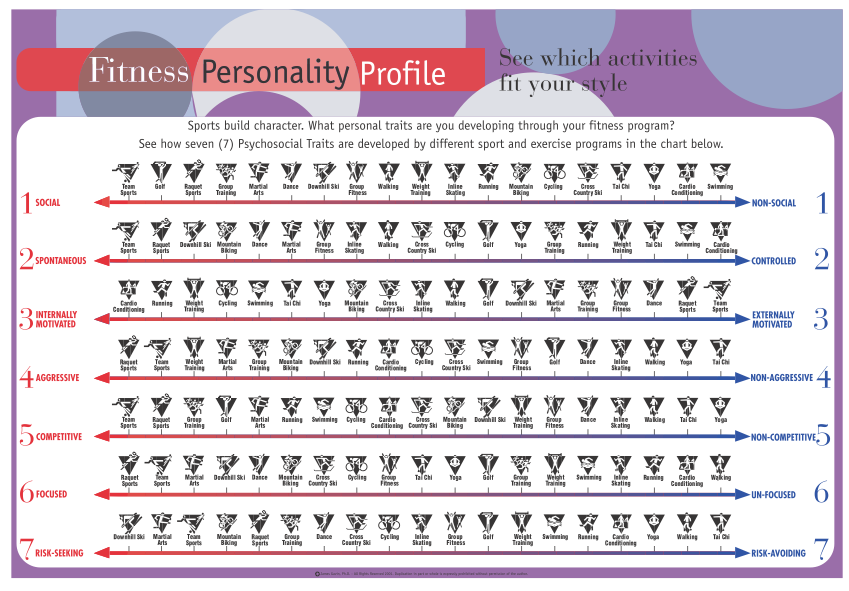
(5) Here's a nice and easy chart that relates fitness activity with your personality type. You'll be much more inclined to partake in physical activities that are suited to your personality and that you find fun!
(6) I'm fascinated by surgery primarily because I see so much engineering involved in it. Here's an interesting piece: http://well.blogs.nytimes.com/2013/10/31/a-vital-measure-your-surgeons-skill/
on surgical skill. To follow-up with this, I've posted this before last year but as a reminder we can and should always strive for improvement in all avenues in life: Coaching a Surgeon
For the past year now I've been engaged in the relentless pursuit of how to become an expert in a field. I really don't know what kind of medicine I want to do, but one I do know is that whatever I do I want to be highly specialized and have the opportunity to be innovative.
(7) Lastly, in honor of Halloween find out your fitness age!
Link is from this article on fitness age from the Times.
I'm 24 yay!
Sunday, October 27, 2013
Medical Musings Part three: Medicine and Mindfulness, Other news
Another Lengthy one, but filled with info on mindfulness, yoga, and better health!
(1) I am trying to practice what I preach. I want to be stronger and I want to be a physician that doesn't lose sight of why I went into a really tough profession in the first place. I realized that before I get there I had to fix some things about me along the way. Essentially, I recognized that I can best serve by example and by already taking care of myself. Thus, I picked up some super important things in my time in Boston many of which I posted in my previous Medical Musings posts.
The importance of mindfulness. This isn't just some hokey spiritual thing, I think at its core it really means being aware of yourself and your surroundings and acknowledging the value in all living things. Meditation and mindful practice has been proven to improve cognition, reduce stress, improves attention and my list can go on, just pubmed though to find more! The hospitals I've been affiliated with have even offered meditation classes for employees and patients.
My point of bringing this up is that being a practicing physician is a profession that requires immense sacrifice, sometimes of oneself and one's needs. These articles http://opinionator.blogs.nytimes.com/2013/10/02/who-will-heal-the-doctors/?src=recg&_r=3 and http://opinionator.blogs.nytimes.com/2013/09/18/medicines-search-for-meaning/ and http://well.blogs.nytimes.com/2013/09/26/easing-doctor-burnout-with-mindfulness/ have illustrated that this can happen in any specialty and the process by which this happens can be akin to living in a torturous hell. What I like is that they offer a solution that might help is mindfulness--workshops and lifestyle changes that can be made even amidst a 100 hour work week.
http://www.fammed.wisc.edu/mindfulness
http://www.ishiprograms.org/programs/medical-educators-students/
I wanted to bring this up first because I wanted to present and propose something to my readers. As facebook and other social media may appear to bring us closer together, I sincerely believe the reality is that it does the exact opposite. This recent study has actually illustrated that social media/the internet makes us feel more apart and lonely. What does this all have to do with mindfulness? The point I'm trying to make is that mindfulness and being alone are not one in the same. The internet has effectually tricked us into believing we are not alone. Instead of falling into the trap of thinking our lives are filled (with the internet) I urge my readers to take that time to meditate, notice others and your surroundings, and spend the time more meaningfully. Mindfulness is a state of heightened awareness (to yourself and by extension to others.) Meditation is the personal practice of mindfulness, but its application extends far beyond the self and its benefits can (rather significantly) improve your life as well as the lives of those around you. The internet is not real. I mean this in the sense that you cannot touch, feel, smell a webpage. It does not give us memories in the same way as going out and being a part of the world does. Seek to notice your world with all your senses. Become fully engaged. Even sniff a little. Perhaps if more of us did this there would be less depression. These are very abstract ideas and I promise I will spend the time to breakdown a more elucidated discussion of this later, but the big take away is to just be present and seek to experience the world and all it has to offer with your whole self--not just your mind/vision engaged in an unreal, intangible world of the internet; if for no better motivation than when you leave this earth you will wish you had spent more time in reality rather than living in the virtual world.
(2) I talked in my previous post about choosing hormone-free meat and antibiotic resistance is a major reason to do so. The recent outbreaks of salmonella food-poisoning (http://www.nytimes.com/2013/10/16/opinion/bittman-should-you-eat-chicken.html?src=recg) and their resistance to antibiotics (http://www.nytimes.com/2013/10/19/opinion/continuing-salmonella-outbreaks.html?src=recg) is another reason why opting for grass-fed meat that were grown without antibiotics is a good choice.
(3) A little word about yoga. I live upstairs from a yoga studio so I decided to give it a second chance. I had tried yoga many years ago and did not take to it since I felt it was too slow-paced. This time, however, I have joined out of necessity since there really isn't a close enough spa to where I live that offers deep-tissue massages and I am having some tension in my shoulder. Anyway, what I like about yoga is that it is a solid hour to do something beneficial for my body and to focus on my body. I can't remember the last time I had that. Even when I would spa-hop on a weekly basis back in Boston my mind was always elsewhere, but in yoga (and this is a hot-yoga studio) I am forced to really concentrate on my body. Yes it's still slow, but the difference is that I am more mindful and have the ability to calm my mind--something I did not have in my early 20s. I also want to become better acclimated to being active in 93-degree weather considering the earth is not getting any cooler and I need to be able to withstand hotter temperatures and be active in them in order to survive and evolve as a human with Global Warming and all. Additionally, as I devour The 4-hour chef and plow through grad school (which I am LOVING by the way) I am inspired every day to really learn anything I stumble upon, even if it doesn't interest me, and I am driven to become extremely skilled in it. That motivation alone drives me to go back to yoga and exceed what I did the last time. As an Indian person, I do find it odd how mainstream yoga has become that a lot of studios have deviated so far from its spiritual and mental roots. So much so that it really does seem at times that some places are just bastardizing my culture (and also the Sanskrit language.) The thing is though, I have to learn somewhere so I am putting that aside and luckily the studio I'm at right now has been ok so far. The fact that many of the ladies that are at this studio are over 40 with multiple children and having amazing bodies, are glowing, and look like they're 20-That's reason enough to participate. Anyway, here's an infographic on how yoga changes your body the day you begin.
Saturday, October 12, 2013
Medical Musings Part Deux: Budget Cuts, Medical Teaching, Healthy living/Food for Thought!
(1) Not much more can be said than what this article has already articulated, but the point is that research and technology are important to progress in a society. The Nobel prizes were announced this past week for physiology/medicine, physics and chem and they illustrates the profound impact that basic science research has on not just medicine and technology, but also on society. Curtailing the funding for such research is equivalent to curtailing significant progress in medicine. I have stated in previous posts that I believe that medicine (in all its forms) collectively enhances a society. In understanding ourselves at the molecular level we not only understand each other better, but also understand the world in which we live in far better. We are governed by science and what can be proven scientifically is something that can be applied cosmically. By doing we begin to deepen our progress as a civilization
(2) I love this posting primarily because it is from a physician of my generation that foresees the issues of compromising quality healthcare just to meet and beat the numbers. In a few of Atul Gawande's books he also addressed the urgency of focusing on providing quality healthcare through small changes that end up having a larger impact on healthcare expenditures. (I'm referring to both the Checklist Manifesto and implementing handwashing in rural areas in third world countries as presented in Better.) Perhaps the answer isn't succumbing to the trivial nuance in order to save money. This article alone indicates that the problems run much deeper than that (yes, a bag of saline can cost $500 when you're in a hospital and yes you most likely paid that amount if you ever ended up in the ER or were hospitalized.) As a future physician, I seek to take the pledge to become more conscientious about healthcare and expenses but not at the cost of treating someone with quality medical care. I believe the answer lies at the cross-roads of simple practicality and a little ingenuity.
FOOD FOR THOUGHT
(3) In light of my recent post on the Healthcare Exchange, I have decided that I want to start some postings about health, food, and cooking in a segment called Food For Thought. First of all, and needless to say, I've taken way to long to apply to medical school, let alone get in and pass and become a doctor. I believe things will eventually work out, but there's no reason I should not act now to better my community's health knowing what I know and having a plethora of resources in front of me as it is. This is especially important since the people in my state are not eligible for the recent Exchange, they can at least use this blog to get free tips and more education on eating healthier. I firmly believe that part of why healthcare costs are so high is that healthcare education is aberrant. I'm still learning a lot about food and it wasn't until recently that I realized how ignorant I was on it. Here are a series of my go-to guides that I use to make meal plans. Yes, Step 1 is making meal-plans. Knowing what you need to buy before you go to the grocery store is a simple way to save time and money and calories. Having something you've already prepared ahead of time in the fridge is a great way to avoid impromptu snack purchases. Mainly, the world will be full of packaged nonsense but by planning you are two steps ahead that you won't be hungry when you're around the packaged goods. As with all planning, be flexible, but having a plan is critical to success:
Ok looks like this will become a 3 parter! Stay tuned for more healthcare/medicine related stuff and sorry for the length--just have so much info out there that I wanted compiled and I hope it is helping someone!
(2) I love this posting primarily because it is from a physician of my generation that foresees the issues of compromising quality healthcare just to meet and beat the numbers. In a few of Atul Gawande's books he also addressed the urgency of focusing on providing quality healthcare through small changes that end up having a larger impact on healthcare expenditures. (I'm referring to both the Checklist Manifesto and implementing handwashing in rural areas in third world countries as presented in Better.) Perhaps the answer isn't succumbing to the trivial nuance in order to save money. This article alone indicates that the problems run much deeper than that (yes, a bag of saline can cost $500 when you're in a hospital and yes you most likely paid that amount if you ever ended up in the ER or were hospitalized.) As a future physician, I seek to take the pledge to become more conscientious about healthcare and expenses but not at the cost of treating someone with quality medical care. I believe the answer lies at the cross-roads of simple practicality and a little ingenuity.
FOOD FOR THOUGHT
(3) In light of my recent post on the Healthcare Exchange, I have decided that I want to start some postings about health, food, and cooking in a segment called Food For Thought. First of all, and needless to say, I've taken way to long to apply to medical school, let alone get in and pass and become a doctor. I believe things will eventually work out, but there's no reason I should not act now to better my community's health knowing what I know and having a plethora of resources in front of me as it is. This is especially important since the people in my state are not eligible for the recent Exchange, they can at least use this blog to get free tips and more education on eating healthier. I firmly believe that part of why healthcare costs are so high is that healthcare education is aberrant. I'm still learning a lot about food and it wasn't until recently that I realized how ignorant I was on it. Here are a series of my go-to guides that I use to make meal plans. Yes, Step 1 is making meal-plans. Knowing what you need to buy before you go to the grocery store is a simple way to save time and money and calories. Having something you've already prepared ahead of time in the fridge is a great way to avoid impromptu snack purchases. Mainly, the world will be full of packaged nonsense but by planning you are two steps ahead that you won't be hungry when you're around the packaged goods. As with all planning, be flexible, but having a plan is critical to success:

- If anyone is at a loss as to where to start on eating healthier use this infographic guide: www.bulletproofexec.com/the-complete-illustrated-one-page-bulletproof-diet/
- More or less everything on that chart is very informative and easy to undertake (depending on where you live of course.) Think that switching from regular to diet coke or not munching on sugar cookies every day is helping you? Well think about what else you are eating. Potatoes and sandwiches can often be just as bad. This article tells us that not everything is as it seems. I've started cooking again and I feel better already. I'll post my recipes as they come (probably on a different blog since I don't want to clutter maritime adventures and act like a foodie.) I'm learning too so I'm not entirely sugar or fat or grain free.
- I've recently placed more importance for antibiotic free meat. The health effects alone are reason enough, but my massage therapist also brought to light a totally different factor: how can anything/animal that was tortured its whole life, injected with hormones/antibiotics, and killed with malice provide meat that is good for you? Something that was killed through malice can neither physically nor spiritually have value left in it. Basically, you're eating a tortured soul. Additionally, in my next post I have an article about the antibiotic resistance bacteria. Just know that there is a relationship between the drugs given to meat to keep them "clean" as they are stuffed in close quarters with other animals and the bugs that affect humans that are drug-resistant. (Usually they're not the same strain but the bugs are related.)
- Infographic showing that everything must go together, diet, SLEEP, and exercise along with mindfulness/stress reduction. I'm still trying to do my steps (I was competing with my Dad over last summer whose employer had a 12,000 step program) but since I've moved to a less walkable city I'm having a hard time. What I think I might do is post my step count on my weekly posts. The goal is 12,000! Back in Boston I used to average 11,000. Better get moving. And for all y'all who think skimping on sleep is fine, maybe this will make you reconsider.

- And after my bouts of food-poisoning, one of which landed me in the hospital for a week and bedridden for 3 weeks after. here's a guide to food safety.
- Quick rundown on vitamins--what foods have them and what they are good for.

Ok looks like this will become a 3 parter! Stay tuned for more healthcare/medicine related stuff and sorry for the length--just have so much info out there that I wanted compiled and I hope it is helping someone!
Thursday, October 10, 2013
Medical Musings: Part One--Healthcare exchange and women in medicine
Long post so I'll split this into a two parter. I had a lot of random articles I have been saving to post so here's tonight's:
With the recent healthcare exchange, I'd like to post some links and my thoughts:
(1) Despite the effort to expand medicaid there are still a vast majority who need the expansion but will not receive coverage. The eye-opening part of this is that the 26 states that are "not participating in an expansion of Medicaid are home to a disproportionate share of the nation’s poorest uninsured residents." What this means is that a good portion of individuals who need the expansion most (those living in some of the poorest states) will not getting it because the State Government has decided not to participate in the expansion. These states are not only some of the most populous, but also some of the poorest and also have the some of the highest concentrations of illnesses. To distill this down: the poorest and sickest are not benefiting because a choice was made not to allow them to be covered. What happened to the days where the purpose of the government was to consider the welfare of the people? All the people, not just the rich ones. A look at the charts below show that it just so happens that a large portion of these poor and uninsured will be blacks and other minorities. Something tells me that this correlates with the disparity in social mobility between races (another topic that the Times published over the summer.) It's hard to go to work when you're ailing and it's even harder to go to school instead of work when you're buried in medical bills. And it's harder to accumulate wealth when all of it is going towards paying for said medical bills. BAH humbug for the empathy gap.
Here's the fast and easy breakdown: http://www.nytimes.com/interactive/2013/10/02/us/uninsured-americans-map.html?ref=health
For the full article click here: http://www.nytimes.com/2013/10/03/health/millions-of-poor-are-left-uncovered-by-health-law.html
Here's some answers to some common questions about what these changes may bring: http://www.nytimes.com/2013/10/05/your-money/estimating-income-and-other-questions-on-the-health-care-plan.html?nl=todaysheadlines&emc=edit_th_20131005
Here's one more article: http://www.nytimes.com/2013/09/27/business/as-some-companies-turn-to-health-exchanges-ge-goes-another-direction.html?src=recg&_r=3&
(2) Not sure how I missed this at the first go, but as someone who has some interest in academic medicine, it appears that the prospect of succeeding is still a little grim for women unfortunately. As if I need any more evidence about gender discrimination, this is an old study so let's hope the past decade has brought some progress (not necessary to read, but I like to substantiate what I write here with evidence-based results.)
http://annals.org/article.aspx?articleid=713512
http://link.springer.com/article/10.1007%2Fs11606-012-2207-1
Some more links (most are short but the NYtimes one at the end is long but I believe the most important.)
Women Still Missing From Medicine’s Top Ranks and we're also still paid less.
Although apparently this also happens in Silicon Valley and they're know as the Silicon Valley Mafia.
This article is extremely interesting though (why are there so few women in science?)
To briefly comment on this, I was recently shocked to find that the department I used to do research at in Boston (a very very very large hospital) had zero women attendings (full-time physicians.) Sure there were residents (physician's still in training but already with their medical degree and learning how to practice in their specialties), but no female attendings in sight. I did a quick search at my current institution and sure enough, again, no female attendings here either in that particular specialty. Sure there are plenty of excuses and explanations such as this being a grueling surgical specialty that has a lot of manual labor involved and long hours so perhaps women steer away from it. Not really accurate assumptions since they appear to be fine going through the hard 5 year residency training. What is concerning is that although it is great that there are some female residents, who can they look to for guidance and mentorship as well as being examples of respected females in this field? Furthermore, how do the men who are training beside these female surgeons become accustomed to having female superiors and equals if none exist? Additionally, this specialty is a 5 year residency plus 1-2 year fellowship. That means that in the past 5-7 years not a single female was hired as an attending in this specialty despite there being qualified candidates. I'm afraid to look up the numbers of females that graduated from residency in this specialty. Something tells me that it's not zero. This sends the message to male surgeons-in-training that their current female classmates are temporary and will somehow disappear after fellowship or worse just can't "hack-it" along the way and drop out or, at the very least, just aren't real contenders in the field to end up at these top institutions. The fact that there are female residents indicates that they are accepted to train as surgeons, they're just not allowed to get hired and actually practice the craft. Mind you, these are two of the nation's largest hospitals sitting at the forefront of medical care. Precluding women from opportunities to learn and contribute at these institutions, teach at them, and mentor others is a loss for future physicians and future patients. I haven't bothered to fully research this at all institutions so I can only comment on what's in front of me but the prospect doesn't seem promising to say the least.
Subscribe to:
Posts (Atom)